
As an adaptation of his father Stephen Covey’s famous “The 7 Habits of Highly Effective People,” this teen version by his son Sean Covey is another timeless. If you’re wondering, “What are the 7 habits of a highly effective teenager?”, here is a critical summary of the book The7 Habits of Highly Effective Teenagers.

What Are the 7 Habits of a Highly Effective Teenager? The Foundation (Habits 1 to 3)
Habit 1: Be Proactive – Take Responsibility for Your Life
You are the driver of your life, not a passenger. The book explains the difference between what happens to you and how you respond to it.
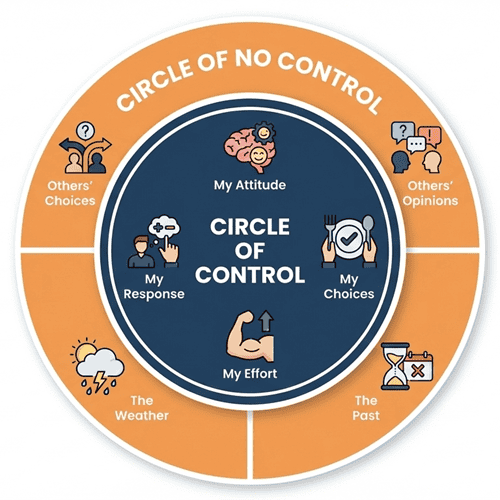
Covey introduces the concept of the “Circle of Control” versus the “Circle of No Control.” Proactive teens focus their energy on things they can control (their attitude, their effort, their choices) rather than things they can’t (other people’s opinions, the weather, their parents’ decisions). He emphasizes using proactive language like “I choose to” instead of reactive language like “I have to” or “You made me.”
Similarly, in the book “Mindset,” Carol Dweck shows that students who believe they can improve through effort dramatically outperform those who believe their abilities are fixed. If you want to know what are the 7 habits of a highly effective teenager, Dweck’s research with thousands of students showed that taking responsibility for your learning and growth leads to better outcomes.
However, Angela Duckworth’s “Grit” adds important nuance. Being proactive doesn’t magically erase systemic barriers like poverty, trauma, and lack of resources. Emphasizing personal responsibility without acknowledging structural inequalities can lead to victim-blaming.
For financial literacy, proactivity is foundational. Teens who take responsibility for their spending, saving, and earning will build better financial futures. However, we must also teach them about economic realities and systemic factors that affect financial outcomes.
Habit 2: Begin with the End in Mind – Define Your Mission and Goals
Before you can succeed, you need to know what success looks like. Covey urges teens to develop a personal mission statement—a written declaration of their values, goals, and purpose.
The book includes “The Great Discovery,” a series of questions designed to help teens identify what matters most to them. Questions like:
“Think of a person who made a positive difference in your life—what qualities does that person have?”
“If you could spend one day in a great library studying anything, what would you study?”
These questions help teens uncover their deeper values and interests.
Covey emphasizes that many teens let others define their path—parents, friends, media, society. He challenges readers to decide for themselves what they want their life to be about.
This is very close to Simon Sinek’s “Start with Why,” which reinforces the importance of a purpose-driven life. People who have a clear “why” (their purpose) are more motivated, resilient, and successful than those who focus only on “what” they do or “how” they do it.
However, Herminia Ibarra’sresearch on identity development presents a compelling counter-perspective. In “Working Identity,” Ibarra shows that identity develops through action and experimentation, not just planning and reflection.
Adam Grant makes a similar point in “Think Again” with his concept of “flexible persistence.” Being too attached to one vision of your future can blind you to better opportunities that emerge. Grant argues for holding your identity loosely enough to pivot when circumstances change.
For teenagers—whose brains are still developing and whose interests may shift dramatically—committing too rigidly to one mission statement at 16 could be limiting rather than liberating.
Our advice is that teens benefit from thinking about their financial values and goals, but they should revisit and revise them regularly. A mission statement about money at 15 might look very different at 18, and that’s okay.
Habit 3: Put First Things First – Prioritize and Manage Time
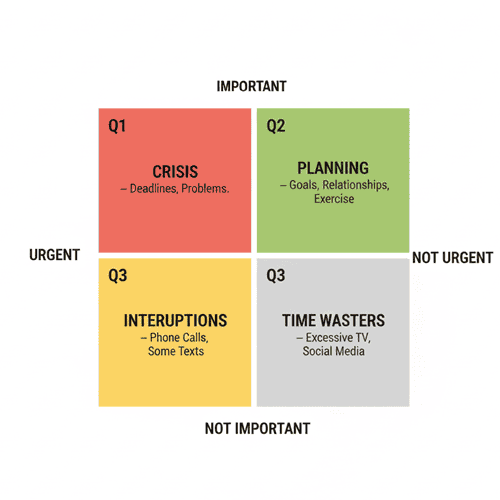
It’s not enough to know what matters—you have to make time for it. Covey reintroduces Eisenhower’s Time Quadrants matrix, dividing activities into four categories based on urgency and importance.
Quadrant 1 is urgent and important (crises, deadlines). Quadrant 2 is important but not urgent (planning, relationships, exercise, studying ahead). Q3 is urgent but not important (many interruptions and phone calls). Q4 is neither urgent nor important (excessive TV, time-wasters).
The key insight: effective people spend more time in Quadrant 2, doing important things before they become urgent. This requires both “willpower” (saying yes to important things) and “won’t power” (saying no to less important things).
Cal Newport’s “Deep Work” strongly supports Covey’s Quadrant 2 principle. Students who can resist the constant pull of urgent but unimportant distractions (texts, social media, shallow tasks) develop greater skills and achieve more.
However, Oliver Burkeman’s “Four Thousand Weeks” offers a refreshing counter-perspective. Burkeman argues that time management advice often creates anxiety by suggesting we can “do it all” if we just optimize enough. Instead, he advocates accepting that we have limited time and must make peace with leaving many things undone.
Money Parents’ tip: Time management directly impacts earning potential and financial health. Teens who can prioritize important financial tasks—like filling out job applications or scholarship forms—over urgent but less important activities will have more opportunities. However, balance matters: working excessive hours for money while sacrificing education or health is counterproductive.
What Are the 7 Habits of a Highly Effective Teenager? Relationship Skills (Habits 4-6)
Habit 4: Think Win-Win – Seek Mutual Benefit

Life isn’t a competition where someone must lose for you to win. Covey argues for an abundance mentality—the belief that there’s enough success, recognition, and resources for everyone.
He contrasts Win-Win thinking with Win-Lose (I win, you lose), Lose-Win (doormat mentality), and Lose-Lose (if I can’t win, I’ll make sure you lose too). The book warns against the “totem pole syndrome”—constantly comparing yourself to others to see if you’re higher or lower.
Covey acknowledges that schools often foster Win-Lose thinking through grading curves, competitive rankings, and limited spots on teams or in programs. He challenges teens to resist this competitive mindset in their relationships.
Adam Grant’s “Give and Take” provides strong research support for Win-Win thinking. Grant studied thousands of people across various professions and found that “givers”—people who help others succeed—ultimately become more successful than “takers” who only look out for themselves. However, Grant makes an important distinction: successful givers have boundaries. “Doormats” who give without limits burn out and fail.
This nuances Covey’s framework. Win-Win doesn’t mean always accommodating others’ needs. Sometimes the right answer is “No Deal”—walking away when someone insists on Win-Lose.
Alfie Kohn takes an even stronger position in “No Contest: The Case Against Competition.” Kohn argues that competition itself—even “healthy” competition—is harmful. His research suggests that competitive structures reduce intrinsic motivation, damage relationships, and decrease performance on complex tasks. From Kohn’s perspective, Covey doesn’t go far enough in challenging competitive paradigms.
Teaching teens to think Win-Win about money combats zero-sum thinking. When one family member’s financial success is celebrated by everyone rather than resented, the whole family benefits. However, in actual financial transactions (negotiating salary, buying a car), teens need to advocate for themselves while seeking fair outcomes.
Habit 5: Seek First to Understand, Then to Be Understood

Most people don’t listen to understand—they listen to reply. Covey identifies five poor listening styles: spacing out, pretend listening, selective listening (only hearing what interests you), word listening (missing emotions and meaning), and self-centered listening (making everything about you).
He teaches “mirroring”—reflecting back what you hear in your own words before sharing your perspective. This validates the other person and ensures you’ve actually understood them. Only after someone feels understood will they be open to understanding your viewpoint.
Marshall Rosenberg’s “Nonviolent Communication” aligns closely with Habit 5. Rosenberg’s framework emphasizes empathic listening—connecting with the feelings and needs behind someone’s words.
However, some communication experts critique the “mirroring” technique as potentially manipulative if not genuinely accompanied by empathy. Simply repeating someone’s words back without true desire to understand can feel condescending or like a therapy technique rather than authentic conversation.
The key distinction: Habit 5 works when the attitude (genuine curiosity and care) drives the technique, not the other way around. Teens need to understand that empathic listening isn’t a trick to get what you want—it’s a way to build real understanding.
Family conflicts about money often stem from not understanding different perspectives. Parents worried about financial security may seem “controlling” to teens who don’t understand the stress of providing for a family. Teens wanting independence may seem “irresponsible” to parents who don’t understand the social pressures teens face. Seeking first to understand can bridge this gap.
Habit 6: Synergize – Work Together for Better Solutions
When people with different perspectives collaborate openly, they create solutions better than any individual could have developed alone. Synergy means:
1 + 1 = 3 or more.
The foundation of synergy is celebrating differences rather than merely tolerating them or, worse, shunning them.
Covey provides a five-step process for getting to synergy: (1) Define the problem or opportunity, (2) Listen to others’ ideas (Their Way), (3) Share your ideas (My Way), (4) Brainstorm new options together, and (5) Find the best solution (High Way).
Scott Page’s research strongly supports the value of diversity for problem-solving. In “The Difference,” Page demonstrates mathematically that diverse teams outperform homogeneous teams of experts when solving complex problems. Different perspectives literally see different solutions.
Susan Cain’s “Quiet” adds an important dimension: synergy doesn’t require everyone to work the same way. Introverts and extroverts can synergize effectively when we create space for different working styles. Not all collaboration needs to be loud brainstorming sessions.
However, research on “groupthink” provides an important counterbalance. Irving Janis’s classic studies showed that cohesive groups often make terrible decisions because members suppress dissent to maintain harmony. Synergy requires genuine openness to disagreement, not just surface-level collaboration.
Additionally, some tasks are simply better done individually. Cal Newport and others have shown that for deep, focused work requiring intense concentration, collaboration can be a distraction rather than an enhancement. The best approach often combines individual thinking time with collaborative synthesis.
Family financial planning works best when everyone’s perspective is heard. Parents have experience and responsibility, but teens have valuable insights about youth culture, technology, and their own needs. Creating a family budget together (rather than parents dictating it) leverages these different perspectives for better solutions everyone can commit to.
What Are the 7 Habits of a Highly Effective Teenager? Renew Yourself Regularly (Habit 7)
Habit 7: Sharpen the Saw

You can’t perform at your best if you’re running on empty. Habit 7 is about renewal in four dimensions: body (exercise, nutrition, sleep), mind (learning, reading, developing new skills), heart (relationships, emotional health), and soul (meditation, reflection, connecting with your values).
Covey uses the metaphor of a saw: if you’re frantically sawing down a tree but never stop to sharpen your saw, you’ll make slow progress despite hard work. Taking time to renew yourself makes everything else more effective.
Research strongly supports the importance of renewal. Dr. Matthew Walker’s “Why We Sleep” presents compelling evidence that sleep deprivation (common among teens) impairs learning, emotional regulation, and physical health.
Anders Ericsson’s research shows that top performers across domains—music, chess, sports—practice less than you’d think (typically 3-5 hours daily of intense practice), but they practice with full focus and then rest completely. Renewal isn’t weakness; it’s strategic.
However, Anne Helen Petersen’s “Can’t Even: How Millennials Became the Burnout Generation” offers an important critique. Petersen argues that framing self-care as a tool for optimization and productivity misses the point. Rest and renewal have inherent value beyond making you more effective. When self-care becomes just another item on an optimization checklist, it can increase stress rather than relieve it.
The healthier framing: Renewal is about being human, not just being effective. You deserve rest, joy, and connection regardless of whether they make you more productive.
Financial wellness is impossible without overall wellness. Teaching teens that renewal is an investment, not an expense, helps them make better decisions about work-life balance. Learn more about this topic in our articles “Easy Online Jobs for Teens” and “Online Business Ideas for Teens.”
So, What are The 7 Habits of a Highly Effective Teenager?
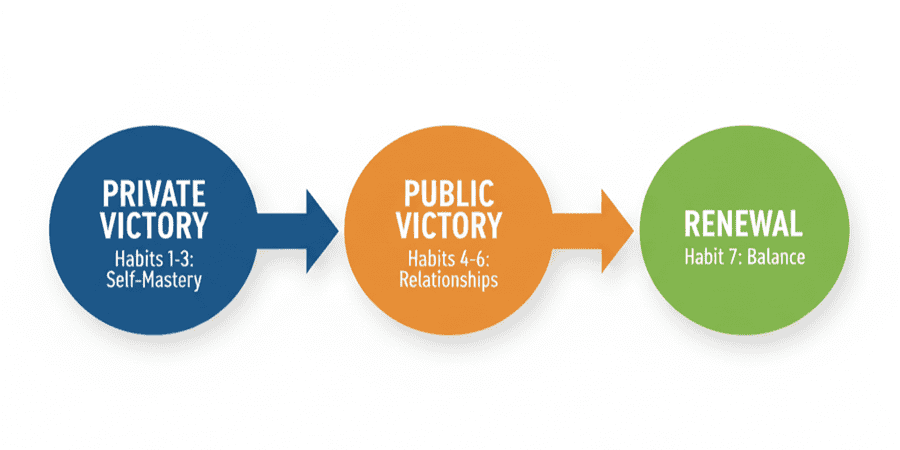
So, what are the 7 habits of a highly effective teenager? They’re a framework for personal development that has helped millions of young people take control of their lives, build better relationships, and achieve their goals.
The habits provide practical, actionable guidance grounded in solid principles. The 7 Habits work best not as rigid rules but as flexible principles adapted to your teen’s unique circumstances, strengths, and challenges.
If this book resonates with your family, you might also explore Stephen R. Covey’s original “The 7 Habits of Highly Effective People” for a deeper dive into the principles, or “The 7 Habits of Highly Effective Families” for practical guidance on applying these habits to family life and parenting. Each book offers a different lens on the same powerful principles, helping you build a household where both financial literacy and character development thrive together.
While you’re building life skills and character, don’t forget to reinforce financial literacy as well—check out our guide to the best children’s books about money to complement the habits with age-appropriate money lessons.
DISCLOSURE: We often review or link to products and services we believe you might find helpful. This article contains affiliate links, which means if you click a link and make a purchase, we may receive a small commission at no extra cost to you. This helps us keep MoneyParents.com running and continue providing free financial education content for families.
Discover more from Money Parents
Subscribe to get the latest posts sent to your email.