
Entrepreneurship for kids often starts with something fun, like running a lemonade stand. Beyond being a classic summer activity, this is one of the most popular ways American kids learn about business and life.
This article will explore what your child can learn by engaging in this venture. And by “lemonade stand,” we also include other kid-led projects, such as selling homemade cookies, baked goods, soda, candy, chips, donuts, popsicles, or even t-shirts.

Entrepreneurship for Kids Lesson One – Investment Basics
To operate a lemonade stand, kids must first understand the concepts of investment and return on investment. To launch their lemonade stand, kids need to invest in some ingredients, like lemons and sugar. Then, they need to add their consumables, like cups, straws, and latex gloves. This is an opportunity to learn how to compare prices, affordability, and value for money.

There are bigger investments to be considered, like a table, a tablecloth, an umbrella or a tent, a cooler, pitchers, serving trays, a cash box, and a card reader. For these, you can either “rent” them to your child for a symbolic price or just let them borrow them.
In addition, the child needs to understand the difference between variable and fixed costs. Variable costs fluctuate according to the number of lemonades sold, like basic ingredients and consumables. While fixed costs are what they need to pay whether they make sales or not, like rent, wages, and debt.
Ready to get started? Grab our free printable Kids Business Plan before you continue to the next stage.
How to Determine a Selling Price

The purpose of any business is to make money. To do so, the sales need to cover all the costs plus a little extra money called profit. So, the selling price is one of the most important decisions to make.
Here is a complete guide to help your kid decide the selling price for their lemonade. Keep on reading! We will tell you how to adjust these steps to your kid’s age and level of understanding:
- First step: The child needs to guesstimate the number of sales they will make, for example, 100 lemonades per day. More on how to make this estimation in the next section about marketing.
- Second step: The child needs to calculate the variable costs per lemonade. This includes the price of lemon, sugar, water, syrup, ice, cups, straws, and latex gloves. For example, if 50 plastic cups cost $5, then, for every lemonade, the cost of the cup is 10 cents.
- Third step: The kid needs to calculate the fixed costs per lemonade. To do this, they need to divide their rent, debt, and wages by the number of lemonades they are selling. For example, if their rent is $20 and they project to sell 100 lemonades, then the cost of the rent per lemonade is 20 cents.
- Fourth step: Sum up all the costs and add the profit margin. For example, if the total cost per lemonade (variable and fixed costs) is $4, they can decide to sell it for $5, which is a 20% margin.
- Fifth step: Check if your selling price is too high or too low. Compare it to prices from other lemonade shops in your area. Decide if you want to increase your price or try to decrease it by lowering your costs.
- Bonus step: If you want to sell different drink sizes and flavored syrups for an extra cost, you’ll have to add that to the equation.
You might think this is too much for a child to grasp at once, especially at a younger age. Don’t worry, we’ve got you! There are many ways to simplify these calculations. For example, you can skip the fixed costs if you are lending them the material and the garden for free. In this case, you only need to calculate the variable costs to figure out how much a lemonade costs.
For younger kids, you can make it even simpler. Determine the cost per lemonade yourself, and then ask them to decide on the selling price. For example, instead of talking about a percentage of margin, simply add $1 or $2 profit per lemonade. More details on age-appropriate financial education in our article How to Teach Kids About Money Age by Age. The purpose is to involve your child in a fun math exercise and make them understand how selling prices are set.
Marketing Basics in Entrepreneurship for Kids – The 4Ps

Having a product to sell is awesome, but we need to make sure that people know about it and come to buy it. For this, you can use the 4Ps of the marketing mix: Product, Place, Promotion, Price. We already talked about Price in the previous section, “How to Determine a Selling Price.” And here are kid-friendly marketing lessons to teach your child about Product, Place, and Promotion:
- Is this the right time to sell lemonade: Fresh drinks like lemonade are more popular on hot summer days. If it is winter, maybe you should postpone this project until spring or summer, or sell a different product like homemade cookies or baked goods. Thinking seasonally can open up great opportunities, such as these fun business ideas for Halloween.
- Sales projection and market research: To do this, your kid can ask other kids in the same neighborhood for their feedback on their own experience running a lemonade stand.
- Choosing the right location to maximize sales: Ask questions like: “Are there enough passersby here?” “Should we ask permission to install our lemonade stand in a friend’s front garden instead?” “Are there other lemonade shops close by?” “Is there a park or a carnival where we can sell our lemonade?”
- Creating attractive posters or flyers: Choose a fun name for your lemonade stand and help your child develop their creativity by designing an eye-catching poster. There are plenty of templates on Canva for inspiration. Include information like dates and location, then print and distribute the posters around your neighborhood and local school.
- Online marketing: Send messages to friends and neighbors about your project. Look for local Facebook groups where you can advertise for your lemonade stand and attract more customers.
- Paint your stand in bright colors like yellow and green. Add balloons and a big sign advertising what you are selling and the price. Make it at home to minimize costs, learn to be creative, and use available resources.
- Advertise the cause you are collecting money for: If your purpose is to collect money for a charity, that’s a very noble cause. Make it clear, as this might attract more customers.
- Other marketing techniques include bundle deals like offering a small discount when a number of items are bought together.
You’re all set! Everything is ready for the big opening day.
Customer Service, Self-confidence, and Speaking to Other People

Part of teaching entrepreneurship for kids is understanding that a business’s success depends on its customers’ satisfaction. A happy customer will come back. They will also talk positively about you to their friends and family, which will attract more customers.
Here are the things that your child will learn:
- Listening and speaking to customers: Saying hello and thank you, listening actively, and responding to the customer’s request builds your child’s self-confidence, as well as their communication and public speaking skills.
- Problem-solving: Your kids will learn from their mistakes, for example, what to do when they run out of supplies.
- Being polite and courteous: Your child will learn how to respond politely when they are given feedback, which reinforces their emotional intelligence and communication skills.
- Collaboration with colleagues: Your child might be running this business with a sibling, a friend, or with you. Working with other people will teach them teamwork.
- Food hygiene: Washing hands frequently, keeping materials and surfaces clean, and handling food and drinks properly are other skills that your kid will practice.
Learning these social skills will set your kid up for success in running their own business in the future or making the right connections in the corporate world. It is one of the 13 money lessons that rich people teach their kids.
Calculation and Money Handling in Entrepreneurship for Kids

Selling and getting paid helps with the kids’ mental math and makes them understand the value of things. Kids will practice addition and multiplication to figure out the cost of an order. They will use subtraction to work out how much change to give each customer.
Your kid will also learn basic accounting. Bookkeeping and tracking revenue and expenses are essential skills for an entrepreneur.
Other learnings from money handling are responsibility and ethics. By being responsible for the “cash box”, kids learn trustworthiness and the importance of accurately handling money.
Entrepreneurship for kids is not easy, and mistakes will happen, like a miscounted sale or running out of change. Use these as learning opportunities to practice problem-solving and taking responsibility.
Entrepreneurship for Kids is About Patience and Hard Work

Operating a lemonade stand implies long working hours, patience, and resilience. When others are playing video games or hanging out with friends, your child will be working hard on their project, and that should be celebrated. Acknowledge that it is a big sacrifice for them, but it will pay off in the end. This teaches your child discipline and delayed gratification.
Decide with your kid their working hours, the number of days they want to run it, and whether or not they are getting help from siblings or friends (with whom they will need to share their profit, of course). By operating a lemonade stand, your kids will see that money is earned through hard work and effort.
Let The Child Decide What They Want to Do With Their Profit

It is time to celebrate the fruit of your child’s efforts and hard work. Teach them first the difference between revenue and profit, and introduce them to the concept of return on investment (ROI), the basic lesson of entrepreneurship for kids.
Then, show them all the positive things that they can do with their earnings. The child can use some of the money to treat themselves to something they wanted, reinvest the money in a bigger stand, and/or save it for an important expense like a new computer or for college.
As parents, we also must teach our kids to be generous. A portion of the money should go to a charity or to treat other members of the family. Unless it was agreed from the beginning that they are collecting money for a certain cause, it is good to donate at least 10% of their profit.
Deciding what to do with their money introduces the kids to financial planning and budgeting. They understand that money is not only meant to be spent, but it can serve different purposes and should be used as a means to achieve important goals, like their vision board goals.
Things to Take into Consideration by the Parents
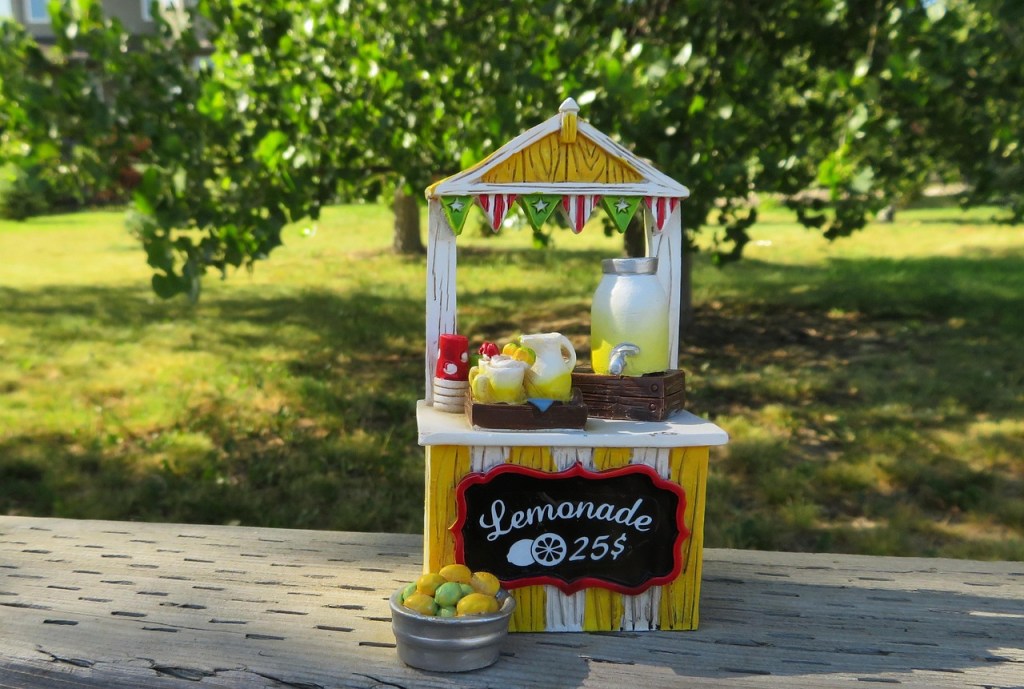
In some states, there are laws and regulations against lemonade stands due to concerns like child labor, food poisoning, or unauthorized use of public space. Most states do permit this kind of venture if it is supervised by an adult (over 18), cleanliness standards are respected, and the stand is on your private property, or you have permission. We advise you to check the law in your state and adjust accordingly.
In addition, make sure that the location is safe. An adult must always be in the vicinity to ensure that the kids are not accosted by ill-intentioned people.
Also, manage your kid’s expectations. Despite all the hard work that the child put into their business, the lemonade stand might not be profitable. In this case, seize the opportunity to sit down and reflect on what went well and what could be improved. Could you reduce your costs? What can you improve about your advertising? Was there too much competition in the area? A failure should not discourage your child; quite the opposite. They should put what they learnt into practice and try again.
Entrepreneurship for Kids – How to Extend the Learning

Try to repeat this business adventure a few times with your kid. For example, you can swap the lemonade for another type of product or offer a larger variety of products. Check also our guide to successful business ideas for kids.
You can also involve your child in the financial planning of the business by working out together the details of the return on investment, trying new business strategies, or even writing an income and expenses sheet.
These early entrepreneurial experiences are building blocks for future leadership success. The skills your child develops through their lemonade stand—problem-solving, financial planning, customer service, and resilience—are the same qualities that can help them learn how to become a CEO at a young age. They might even decide that this type of entrepreneurship is not for them and decide to start small digital ventures for teens or try working online instead. Every endeavor is preparing them for bigger opportunities ahead.
We understand that this might be a learning curve for you too as a parent. Our mission is to provide you with guidance so you can teach your kids about money. This is why we invite you to read our article about Why Teaching Kids About Money Starts With You.