
Imagine having an extra $10,000 in your savings account. For many families, $10,000 feels like an impossible goal—but learning how to save $10,000 in a year is more achievable than you might think.
The truth is, figuring out how to save $10,000 in a year just requires a solid plan and consistent habits. This guide will show you realistic strategies that work for real families, whether you have 12 months, 6 months, or even 3 months to reach your goal.
Key Takeaways
- Learning how to save $10,000 in a year means setting aside $833/month, $192/week, or about $27.40/day
- Start with low-effort savings strategies and scale up to bigger lifestyle changes if needed
- Faster timelines (6 months or 3 months) require progressively more aggressive approaches
- Progress is more important than perfection—any amount saved is a win
- Automation and tracking tools make the process significantly easier
- Your family’s well-being should always come before any savings goal

How to Save $10,000 in a Year
Let’s break it down to make this feel concrete. To save $10,000 in 12 months, you need to set aside:
- $833 per month
- $192 per week
- $27.40 per day
It suddenly feels much more manageable, doesn’t it? The key to figuring out how to save $10,000 in a year is finding the right combination of cutting expenses and increasing income that works for your family.
The 12-month approach to how to save $10,000 in a year is sustainable for most families. It requires discipline but not deprivation, and allows you to build healthy financial habits that will last beyond this single goal.
Step 1: Audit Your Current Spending to Save $10,000 in a Year
Many families are shocked to discover they’re spending hundreds of dollars monthly on things they barely use or don’t even remember signing up for:
Track everything for 30 days. Use apps or a pen and paper to record and categorize your spending. The important thing is capturing every purchase, no matter how small.
Identify your “big three.” For most families, these are housing, transportation, and food. These are where you’ll find the biggest opportunities for savings.
Find your “latte factor.” This term, popularized by financial author David Bach, refers to small recurring expenses that add up over time. Unused gym memberships, subscription services you’ve forgotten about, daily convenience store stops, and impulse purchases all fall into this category.
Look for patterns. Do you spend more when you’re stressed? Do certain activities with friends always lead to expensive outings? Does weekend boredom lead to shopping trips? Understanding your spending triggers helps you address the root causes.
Step 2: Create Your Strategy for How to Save $10,000 in a Year
Now, it’s time to create a realistic plan to redirect $833 monthly into savings. Here’s an example:
| Strategy | Monthly Savings | What to Do Examples |
| Reduce dining out (4x → 1x/week) | $200 | Cook family meals, pack lunches for work and school |
| Cancel unused subscriptions | $100 | Streaming services, gym memberships, app subscriptions |
| Lower grocery bill (meal planning) | $150 | Batch cooking, buy store brands, shop sales with a list |
| Reduce energy costs | $50 | LED bulbs, adjust thermostat, unplug devices |
| Cut entertainment expenses | $100 | Free community events, library resources, park visits |
| Transportation savings | $150 | Carpool when possible, combine errands, bike for short trips |
| Negotiate bills | $83 | Call providers for better rates on insurance, phone, internet |
| Total | $833 |
Step 3: Painless Ways to Save (Beginner Level)
Automate transfers to savings on payday. When you “pay yourself first“, you remove willpower from the equation entirely.
Use cash-back apps for regular purchases. These apps give you money back on purchases you’re already making. It’s not going to make you rich, but you can earn $20-50 monthly.
Switch to a high-yield savings account. Traditional banks pay almost nothing in interest, but high-yield savings accounts currently offer rates around 4-5%.
Implement the 30-day rule for non-essential purchases. When you want to buy something that’s not a necessity, wait 30 days. You’ll be amazed at how many things you completely forget about or lose interest in.
Pack lunches and make coffee at home. This is classic advice for a reason—it works. If you spend $12 on lunch and $5 on coffee each workday, that’s $85 weekly or $340 monthly—which covers 40% of your monthly savings goal.
Use the library for books, movies, and free kids’ activities. Beyond books, modern libraries offer free movies, audiobooks, ebooks, video games, and often host free workshops, storytimes, and educational programs for kids.
Plan no-spend weekends as family bonding time. Have a picnic at the park, play board games, do a home movie night with popcorn, or explore local hiking trails. These weekends often become favorite family memories and save $100-200 each time.
Step 4: Intermediate Money Moves
Negotiate recurring bills. Simply asking for a better rate or mentioning competitor pricing often results in immediate discounts. Spending one hour on these calls can save you $50-100 monthly—that’s potentially $600-1,200 saved annually, more than 10% of your goal to save $10,000 in a year.
Sell unused items. Most families have hundreds or thousands of dollars worth of stuff they don’t use. Facebook Marketplace, eBay, and Poshmark make it easier than ever to turn clutter into cash.
Start a simple side hustle. Tutor students, offer virtual assistant services, or dog-sit. Even 5-10 hours weekly at $20-50 per hour adds $400-2,000 monthly to your savings fund.
Downgrade one major expense. One major downgrade can save $200-500 monthly.
Optimize tax withholding. If you receive large tax refunds each year, you’re essentially giving the government an interest-free loan. Adjust your W-4 withholding so you get more money in each paycheck that you can redirect to savings immediately. Use the IRS withholding calculator to ensure you won’t owe at tax time.
Step 5: Increase Income to Reach Your $10,000 Goal
Ask for a raise. Research salary data for your position, document your contributions and achievements, and schedule a conversation with your manager. Even a 3-5% raise on a $50,000 salary is an extra $1,500-2,500 annually.
Freelance your existing skills. Chances are, someone needs your skills on a project basis. Designers, writers, bookkeepers, programmers, consultants, and marketers can all find freelance work relatively easily.
Start a small online business. If you’re crafty, consider selling on Etsy. If you have expertise in any area, create digital products like templates, guides, or courses. If you’re good at sourcing deals, buy items at thrift stores or clearance sales and resell them for profit.
Rent out space. Do you have a parking spot in a desirable area? Have a spare room? Even renting out storage space in your garage or basement can generate $50-200 monthly.
Seasonal work or part-time gig. Retail stores, restaurants, and delivery services almost always need extra help, especially during busy seasons. Working 10-15 hours weekly can add $800-1,500 to your monthly income.
Step 6: Track Progress and Stay Motivated on Your Journey
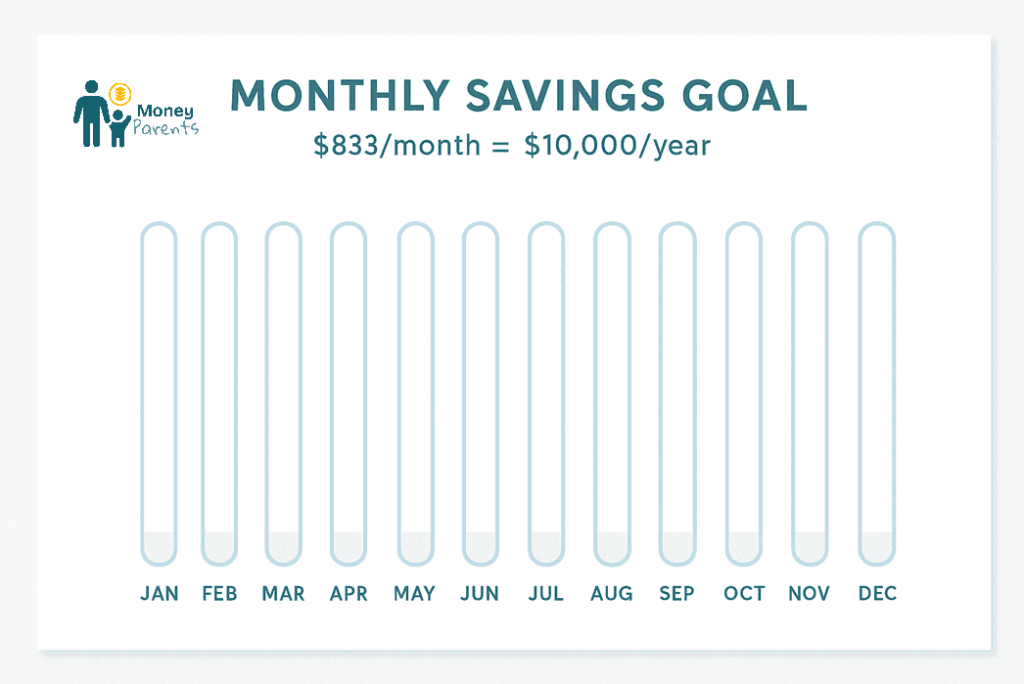
Saving $10,000 is a marathon, not a sprint. Here’s how to stay on track as you work on how to save $10,000 in a year:
Use a visual tracker. There’s something psychologically powerful about seeing your progress. Use a savings chart, an app, or even a paper thermometer that you color in as you save. e
Celebrate milestones. When you hit $2,500, $5,000, and $7,500, celebrate! This doesn’t mean spending a bunch of money, but acknowledge the achievement. Give yourself and your family guilt-free permission to enjoy something small you’ve been wanting.
Involve kids age-appropriately. This is a golden teaching opportunity. You’re modeling financial responsibility that will impact them for life.
Join online accountability groups or challenges on Facebook or Reddit. They keep you inspired and accountable.
Step 7: Protecting Your Well-being During the Savings Journey
Here’s something most articles about how to save $10,000 in a year won’t tell you: your mental health and family relationships are more valuable than any financial goal.
Budget for small treats and family time. These “pressure release valves” actually help you save more in the long run by preventing the restrict-binge cycle caused by living in scarcity.
Keep communication open with your partner about financial stress. If one person is struggling more than the other, adjust the plan. Your relationship is worth more than hitting a savings target on a specific timeline.
Don’t sacrifice sleep or health to work extra hours. Yes, a second job can help you save faster, but exhaustion actually costs money. When you’re overtired, you make poor decisions, order takeout instead of cooking, get sick more often, and can’t perform well at your primary job.
Remember that quality time with kids doesn’t require spending. Your presence and attention are what they’ll remember, not expensive entertainment.
Build in “buffer” categories. Don’t create a budget so tight that there’s zero flexibility. Having $50-100 monthly of flexible spending prevents you from feeling trapped and resentful.
How to Save $10,000 in 6 Months
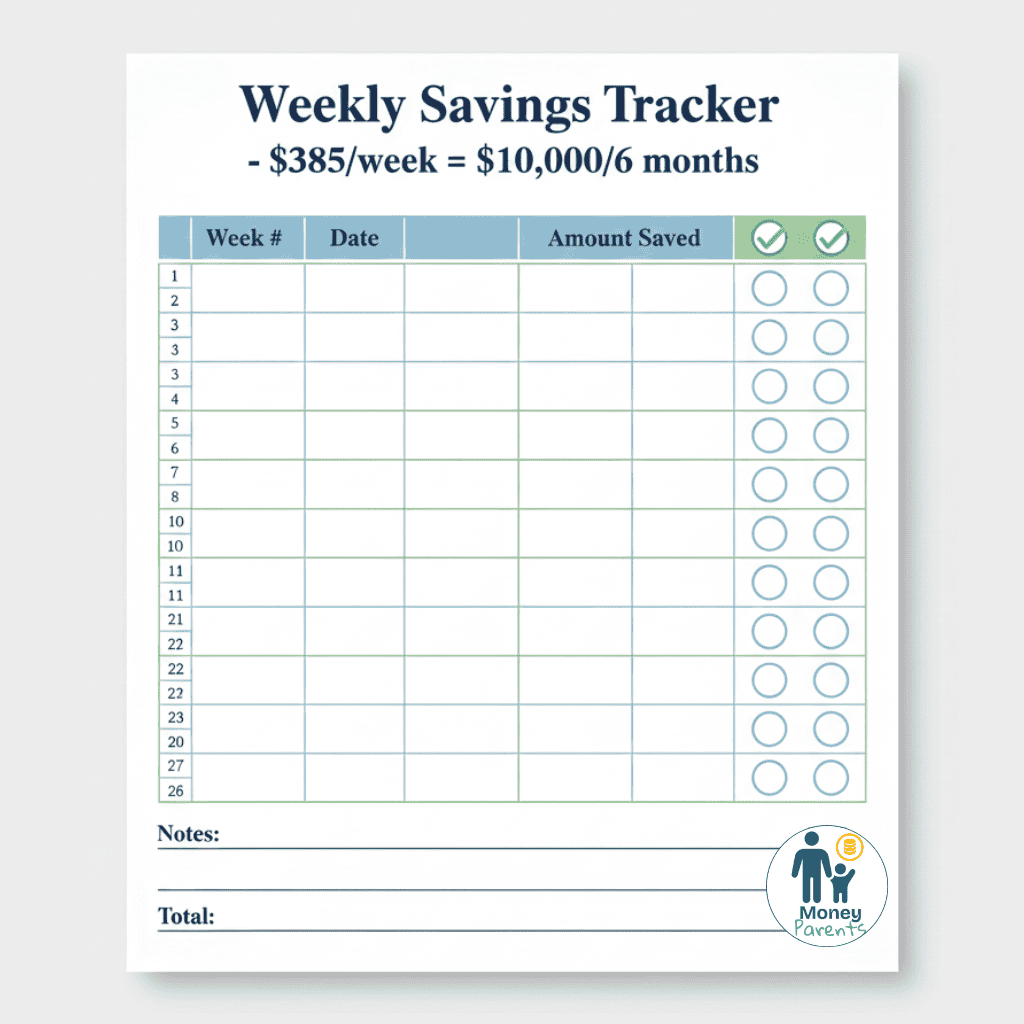
Saving $10,000 in 6 months is significantly more challenging, but it’s definitely achievable. The math looks like this:
- $1,667 per month
- $385 per week
- $55 per day
You Will Need Advanced Savings Strategies
Temporarily freeze all discretionary spending. No restaurants, no entertainment, no new clothes unless absolutely necessary, and no impulse buys. It sounds extreme, but remember—it’s only for six months.
Implement a “no-buy” month for non-essentials. Take the freeze concept further by dedicating one entire month to buying absolutely nothing except necessities: groceries, gas, essential medications, and bills. This reset often reveals how much we spend on autopilot and helps you reduce your expenses even after.
Take on additional work hours or overtime. The time-and-a-half pay rate makes overtime especially valuable. Just be mindful of your energy levels and family time.
Sell bigger-ticket items. Consider selling things like that second car you rarely use, the expensive exercise equipment collecting dust, furniture you don’t need, or electronics you keep “just in case.”
Move in with family temporarily. If you’re renting and have a good relationship with family members, moving in with parents or in-laws for 3-6 months can save thousands in rent payments. Homeowners could explore renting out their property during this time to generate income that covers the mortgage.
Rent out your car when not using it. If you work from home or have access to public transportation, consider renting out your vehicle on Turo. Some people earn $300-600 monthly this way, though you’ll need to account for additional insurance and wear-and-tear.
Income Boosters for Faster Results
Launch a serious side hustle with immediate income potential. Focus on services you can start offering immediately: freelance writing, graphic design, virtual assistance, home cleaning, handyman services, or tutoring.
Take on contract/gig work. Dedicating 15-20 hours weekly to gig work can generate an extra $900-2,000 monthly.
Offer specialized services. Offer consulting, coaching, or specialized services at premium rates. A consultant charging $100-200 per hour only needs to book 8-16 hours monthly to earn an extra $800-3,200.
Maintaining Balance at a Faster Pace
Saving $10,000 in six months puts significant pressure on your time, energy, and family life. Here’s how to stay healthy through the process:
Check in weekly with yourself and your family about stress levels. How is everyone feeling? Does something need to be adjusted? These conversations catch problems before they become crises.
Schedule at least one family connection activity per week. Play games, go to the park, have a movie night, or cook a special meal together.
Remember: your mental health is more valuable than any savings goal. Yes, having $10,000 saved will feel amazing. But not if you achieve it at the cost of your health, your relationships, or your sanity.
Finding Inspiration
Many content creators share their saving journey. For example, YouTuber Leila from Personal Finance with Leila documented her journey paying off student loans and completing a no-buy year. What makes her content so valuable is her transparency about both the successes and struggles.
How to Save $10,000 in 3 Months
Let’s be completely honest up front: saving $10,000 in three months is extremely difficult. The numbers alone tell the story:
- $3,333 per month
- $769 per week
- $110 per day
When This Makes Sense
Emergency situations. You’re facing eviction, need to relocate quickly due to dangerous living conditions, or have an urgent medical situation not covered by insurance.
Time-sensitive opportunities. Perhaps you’ve found a business opportunity with a firm deadline, or there’s a once-in-a-lifetime chance to buy a property at a significant discount, but they need the money within three months.
If your situation doesn’t fit one of these categories, seriously consider the 12-month or 6-month timeline.
Drastic but Effective Measures
Take a second job temporarily. This likely means working 60-70 hours per week total. That’s working your primary job, then heading straight to a second job or working nights and weekends.
Move to cheaper housing. Options include downsizing to a smaller apartment, moving to a less expensive neighborhood, or taking on roommates. Moving has upfront costs, so run the numbers carefully.
Sell a vehicle and go car-free or one-car household. Selling a car eliminates the car payment, insurance, gas, and maintenance all at once. That’s around $400-700 per month.
Cash out unused vacation days. Some employers allow you to convert unused vacation or PTO into cash.
Take on a short-term higher-paying gig. Look for temporary contract positions, seasonal work with premium pay, or short-term specialized work that pays significantly more than your usual rate.
Eliminate ALL non-essential spending. You buy groceries, pay bills, put gas in the car, and that’s it. No restaurants, no convenience purchases, no subscriptions, no new clothes, no gifts, no entertainment purchases. Everything else goes to savings.
Maximum Income Generation With Short-term Intensive Work.
Some industries offer short-term intensive work opportunities. Seasonal work in oil fields, agriculture, fishing, or tourism can pay very well but requires long hours. Traveling contractor positions often pay premium rates precisely because they’re temporary and demanding.
Reality Check and Health Warning
Here’s what you need to understand about attempting to save $10,000 in three months:
Plan your “exit strategy” after hitting the goal. Decide what happens on day 91. Having a clear plan prevents burnout.
This pace can seriously impact your physical and mental health. Monitor yourself honestly for warning signs.
Your family needs you present and healthy more than they need $10,000. Even your own body needs adequate sleep, nutrition, and downtime.
The 3-month savings timeline is extreme by design. It should be reserved for genuine emergencies and time-sensitive opportunities, and limited strictly to 90 days maximum.
Setting the Right Savings Goal: How to Save $10,000 in a Year That Works for Your Family

Clarify exactly why you’re saving $10,000. Having a clear, meaningful goal dramatically increases your likelihood of success.
Common $10,000 Savings Objectives
Emergency fund. Financial experts typically recommend 3-6 months of expenses in an emergency fund. For many families, $10,000 represents a fully-funded emergency fund that can cover unexpected job loss, medical bills, major home repairs, or other financial surprises without going into debt.
Debt payoff. Using $10,000 to eliminate debt frees up monthly cash flow permanently and saves thousands in interest. The psychological relief of being debt-free is equally valuable.
House down payment. While $10,000 might not cover a full down payment, it’s a solid start.
College savings jumpstart. Contributing $10,000 to a 529 plan when your child is young gives that money enough time to grow through compound interest. That initial $10,000 could become $20,000-40,000 or more by the time your child reaches college age.
Family vacation fund. After years of putting off travel, a $10,000 vacation fund can cover a significant trip—maybe even a once-in-a-lifetime experience.
Car purchase. Saving $10,000 lets you buy a reliable used vehicle with cash, avoiding car payments and interest.
Starting a business. Many small businesses can be started with $10,000 or less. This seed money can cover initial inventory, business licenses, website development, equipment, or marketing to get your entrepreneurial dreams off the ground.
Moving expenses. Relocating for a job or family reasons can easily cost $5,000-10,000, and you want to avoid going into debt for it.
Major life events. Perhaps you’re expecting a baby, planning a wedding, or facing a medical procedure and want to be financially prepared.
Choosing Your Timeline for How to Save $10,000 in a Year (or Faster)
Not every timeline is right for every goal. Here’s how to think about matching your timeline to your situation when planning how to save $10,000 in a year or on an accelerated schedule:
| Timeline | Best For | Lifestyle Impact | Risk Level |
| 12 months | Sustainable lifestyle changes, building long-term habits, non-urgent goals | Low to moderate—requires discipline but not deprivation | Low—sustainable and maintainable |
| 6 months | Motivated short-term goal, semi-urgent deadline, moderate time pressure | Moderate to high—significant lifestyle adjustments needed | Medium—challenging but achievable with focus |
| 3 months | Emergency situations, time-sensitive opportunities, crisis response | Very high—dramatic changes to work and spending required | High—can impact health and relationships |
Choose 12 months if: You’re building an emergency fund for the first time, want to develop sustainable money habits, have a goal that’s important but not urgent, want to involve your kids in a year-long financial lesson, or simply want the most balanced approach to how to save $10,000 in a year that won’t disrupt your life significantly.
Choose 6 months if: You have a specific deadline, or feel motivated to push yourself harder for a defined period, knowing there’s an end date.
Choose 3 months if: You’re facing a genuine emergency, have a once-in-a-lifetime opportunity that truly requires immediate action, are in a crisis that requires quick financial resolution, and understand the risks of such an aggressive pace.
Make It Meaningful
Connect savings to values and family priorities. Don’t just save money to save money—connect it to something that genuinely matters.
Involve kids in goal-setting for a teaching moment. Depending on their ages, bring your children into the conversation about the family’s financial goals. Let them understand that the family is working together toward something important. This teaches delayed gratification, goal-setting, teamwork, and financial responsibility—lessons that will serve them their entire lives.
Create a visual representation. Make the goal tangible with a vision board, savings thermometer, or chart showing your progress. Visual reminders keep the goal front-of-mind and make progress feel real.
Managing Expectations: Progress Over Perfection
Here’s an uncomfortable truth about savings goals like how to save $10,000 in a year: they rarely go exactly according to plan.
What to Do When Life Happens
Unexpected expenses are normal. You didn’t fail because your budget couldn’t predict the exact moment your transmission would fail or your child would break their arm. Build flexibility into your expectations from the beginning.
Adjust timeline without abandoning goal. If you planned to save $10,000 in 12 months but an unexpected expense set you back, simply adjust. Maybe it will take 14 months instead. That’s still an enormous accomplishment.
Saving $7,000 instead of $10,000 is still a win. If you set out to save $10,000 but only saved $7,000, you didn’t fail—you saved $7,000 more than you had before.
Consider borrowing strategies from the next level. If you chose a 12-month timeline but progress is slow, look at the strategies in the 6-month section. Similarly, if you’re on a 6-month plan that’s moving too slowly, the 3-month section has even more intensive strategies. However, the 3-month advice is already very strict, and we strongly advise against extending it beyond three months.
When Things Go Better Than Expected

Just as things can go wrong, they can also go surprisingly right.
Windfalls happen. Tax refunds, work bonuses, gifts from family, inheritances, rebates you forgot about, or that $50 bill you found in an old coat—windfalls come in all sizes. When they do, direct them straight to your savings goal.
Expenses lower than projected. Maybe you overestimated your expenses. Perhaps you negotiated a better rate on insurance than expected. When this happens, don’t just spend the difference—redirect it to savings.
Momentum builds motivation. Seeing your savings account grow creates positive momentum. This psychological boost can accelerate your timeline significantly.
The Real Value Beyond the Number
While reaching $10,000 is fantastic, the journey of learning how to save $10,000 in a year teaches you things that are even more valuable than the money:
Financial habits you’ll build. Tracking spending, making intentional purchasing decisions, paying yourself first—you’re building a financial foundation that will serve you for decades.
Skills and discipline that transfer to other goals. Learning to work toward a long-term goal, managing setbacks, and delaying gratification are skills that apply to everything from career advancement to health goals to relationship building. You’re learning how to accomplish difficult things.
Teaching your kids through example. Your children are watching how you handle money, how you work toward goals, and how you respond to challenges.
Stronger family communication about money. Working toward a family savings goal requires talking about money regularly. This creates healthier, more open communication patterns around finances.
Adjusting Your Plan
Flexibility is the key to long-term success with any financial goal. Here’s how to stay adaptable:
Monthly check-ins. Set aside 30 minutes at the end of each month to review your progress. These regular reviews help you course-correct before small problems become big ones.
Celebrating small wins. Every milestone deserves recognition. Celebration reinforces positive behavior and keeps motivation high.
Course-correcting without guilt. When you realize something isn’t working, adjust the plan without beating yourself up. The goal is progress, not punishment.
Knowing when to slow down or pause for your family’s well-being. If pursuing your savings goal is causing serious stress, health problems, relationship damage, or neglect of your children’s needs, it’s time to slow down or pause. Your family’s well-being is non-negotiable. A savings goal can be adjusted; damaged relationships or health are much harder to repair.
Conclusion
Learning how to save $10,000 in a year is an ambitious goal, but it’s absolutely achievable. Whether you choose the sustainable 12-month approach, the more aggressive 6-month timeline, or even the intensive 3-month sprint, the key is finding the right balance between cutting expenses and increasing income that works for your unique situation.
Remember these fundamental truths as you begin your journey on how to save $10,000 in a year:
Start today with one small step—even if it’s just setting up an automatic transfer of $25 weekly or canceling one unused subscription. The journey to $10,000 begins with the first dollar saved.
The process of working toward a big financial goal teaches you skills and builds habits that are just as valuable as the money itself. You’re not just saving $10,000; you’re transforming your relationship with money and modeling financial responsibility for your children.
Progress isn’t linear, and that’s okay. What matters is getting back on track after challenges rather than giving up entirely.
Most importantly, your family’s health and happiness come first. Always. A savings goal should enhance your life and create opportunities, not damage your relationships, compromise your health, or rob you of joy.
The fact that you’re even reading this article and considering how to save $10,000 in a year puts you ahead of most people. You’re taking control of your financial future, and that’s something to be proud of. So take that first step today. Set up your savings account. Make your plan. And remember—whether it takes you 12 months, 18 months, or even longer, every dollar you save is a victory worth celebrating.
Frequently Asked Questions About How to Save $10,000 in a Year
How can I save $10,000 in a year?
To save $10,000 in a year, you need to set aside $833 per month, $192 per week, or about $27 per day. Start by tracking all your current spending for 30 days to identify where your money goes. Then implement a combination of expense-cutting strategies (like reducing dining out, canceling unused subscriptions, and negotiating bills) and income-increasing tactics (such as asking for a raise, starting a side hustle, or taking on freelance work).
Is saving $10,000 in a year realistic for the average family?
Yes, saving $10,000 in a year is realistic for many families, though it requires intentional planning and discipline. If the 12-month timeline feels impossible, consider extending to 18-24 months instead.
What’s the fastest way to save $10,000?
The fastest way to save $10,000 is to combine aggressive expense cuts with significant income increases. This means eliminating all discretionary spending, selling major assets you don’t need, and taking on substantial additional work through a second job or intensive side hustle. However, this is extremely demanding and unsustainable long term. For most families, the 12-month approach offers a better balance of speed and sustainability.
Should I save or pay off debt first?
Generally, you should pay off high-interest debt (anything over 7-8% interest) before saving, as the interest likely exceeds what you’d earn in a savings account. However, everyone should have at least $1,000-2,000 in emergency savings first to avoid going further into debt when unexpected expenses arise. Learn more about this method in Dave Ramsey’s book: The Total Money Makeover.
What should I do with the $10,000 once I save it?
What you do with your $10,000 depends on your original goal. If it’s an emergency fund, keep it in a high-yield savings account where it’s easily accessible but earning 4-5% interest. If you’re saving for a down payment or planned expense within the next 1-3 years, a high-yield savings account or short-term CD works well. For longer-term goals like college savings, consider a 529 plan or investment account where your money can grow over time. Never invest emergency fund money in stocks or other volatile assets.
How do I stay motivated to save $10,000 over a full year?
Staying motivated requires making your progress visible and celebrating milestones. Use a visual tracker like a savings thermometer or chart where you can see your progress grow. Set mini-goals and celebrate when you hit $2,500, $5,000, and $7,500. Involve your family in the goal so everyone is working together. Connect your savings to something meaningful—not just a number, but what that money represents for your family’s future. Join online communities or accountability groups where others are working toward similar goals.
What if I can’t save the full $10,000 by my deadline?
If you saved $7,000 or $8,000, that’s still a tremendous accomplishment and $7,000-8,000 more than you had before. Simply adjust your timeline and keep going, or if progress is consistently slower than expected, borrow some strategies from the more aggressive 6-month plan to accelerate your savings. The most important thing is maintaining forward momentum rather than giving up entirely.
DISCLOSURE: We often review or link to products and services we believe you might find helpful. This article contains affiliate links, which means if you click a link and make a purchase, we may receive a small commission at no extra cost to you. This helps us keep MoneyParents.com running and continue providing free financial education content for families.
Discover more from Money Parents
Subscribe to get the latest posts sent to your email.