
Picture this: It’s the day after Thanksgiving. Your neighbor’s kids are already begging to hit the Black Friday sales, while your child is still talking about yesterday’s gratitude practice at the dinner table. One family is caught in the “more, more, more” cycle. The other? They’re building a foundation for lifelong financial responsibility. The difference? Thanksgiving gratitude.

We live in a world where kids are bombarded with 3,000+ advertising messages daily, where “retail therapy” is normalized, and where social media makes everyone feel like they need the next big thing. But here’s the good news: teaching Thanksgiving gratitude isn’t just about warm feelings and family traditions. It’s one of the most powerful tools you have for raising financially responsible kids.
In this article, you’ll discover the surprising psychology behind gratitude and money, learn why grateful kids spend less impulsively, and get practical strategies to build year-round gratitude habits that transform your child’s relationship with money. Let’s dive in.
Why Thanksgiving Gratitude Matters for Your Child’s Financial Future
Thanksgiving gratitude isn’t just a feel-good practice—it’s a research-backed strategy that shapes how your kids will handle money for the rest of their lives. Understanding the “why” behind this connection helps you approach gratitude teaching with intention and confidence.
The Psychology Behind Thanksgiving Gratitude and Money Mindset

When your child practices Thanksgiving gratitude regularly, something remarkable happens in their brain. Gratitude activates the prefrontal cortex—the part of the brain responsible for decision-making and impulse control. At the same time, it reduces activity in the amygdala, which drives emotional, reactive spending.
Think of gratitude as a mental muscle. The more your kids exercise it, the stronger their resistance to materialism becomes.
Here’s a simple example: Meet Emma and Jake, both 10 years old. Emma’s family practices daily gratitude, while Jake’s family doesn’t discuss thankfulness much beyond Thanksgiving Day.
When both kids receive $50 for their birthdays, their responses are drastically different. Emma pauses and thinks, “I’m grateful I already have my favorite video game. Maybe I’ll save this for something I really need later.” Jake immediately wants to spend it on the latest toy he saw advertised, even though he has similar toys at home gathering dust.
The difference? Emma has developed what psychologists call “hedonic adaptation awareness”—she recognizes that new purchases provide temporary happiness, while Jake is caught in the comparison trap, always chasing the next thing.
This shift from “I need more” to “I appreciate what I have” is the foundation of smart money management. It’s also directly connected to developing an abundance vs scarcity mindset, which shapes every financial decision your child will make.
What Research Says About Grateful Kids and Money
The connection between Thanksgiving gratitude and financial responsibility isn’t just anecdotal—it’s backed by solid research.
A landmark study published in the Journal of Positive Psychology found that adolescents who regularly practiced gratitude were 20% less likely to make impulse purchases compared to their peers. Another study from Northeastern University revealed that grateful individuals were willing to wait 12% longer for larger financial rewards, demonstrating superior delayed gratification skills.
Perhaps most compelling: research from the University of California found that adults who practiced gratitude as children reported 30% higher savings rates and lower credit card debt in their twenties and thirties.
Here’s what the data tells us:
- Grateful children show increased patience when it comes to financial decisions
- They experience less envy when peers have things they don’t
- They’re more satisfied with non-material experiences
- They develop stronger future-oriented thinking (crucial for saving and investing)
These aren’t small differences—they’re life-changing patterns that compound over decades. When you teach Thanksgiving gratitude, you’re not just improving your child’s mood; you’re literally rewiring their financial decision-making system.
How Thanksgiving Gratitude Reduces “I Want That!” Moments

If you’re tired of hearing “Can we buy this?” every time you’re at the store, Thanksgiving gratitude practices might be your secret weapon. Here’s how gratitude creates a natural barrier against constant consumption demands.
Understanding the Gratitude-Contentment Connection
Gratitude and contentment are psychological cousins. When children regularly practice Thanksgiving gratitude, they develop what researchers call “abundance perception”—the feeling that they already have enough.
This doesn’t mean your kids won’t want anything ever again (they’re still kids, after all). But it dramatically reduces the frequency and intensity of those demands.
Here’s why: Most “I want that!” moments stem from a feeling of lack. Kids see something shiny and new, and their brain says, “I don’t have that, and I need it to be happy.” Gratitude flips this script. When your child has been practicing thankfulness for their existing toys, clothes, or experiences, their brain is already in “I have plenty” mode.
The result? Those impulse purchase demands decrease naturally. And when kids do ask for something, they’re more likely to genuinely consider whether they need it—a crucial skill you can reinforce by teaching them to distinguish between need and want.
This contentment doesn’t just benefit your child—it reduces parent stress and can save your family hundreds or even thousands of dollars annually on unnecessary purchases.
Real-World Example: Thanksgiving Gratitude vs. Black Friday Mentality

Let’s compare two families during the holiday season to see Thanksgiving gratitude in action.
Family A (practices Thanksgiving gratitude year-round): It’s Thanksgiving Day, and the Martinez family goes around the table sharing three things they’re grateful for. Their 8-year-old daughter Maya says she’s thankful for her art supplies, her bike, and family game nights. The next morning (Black Friday), the family sees ads for massive toy sales. Maya mentions a few things that look cool, but she’s not begging to go shopping. “I already have so many toys I haven’t played with in a while,” she says. The family stays home, avoids the shopping frenzy, and saves money while reducing stress.
Family B (doesn’t practice regular gratitude): The Johnson family has a nice Thanksgiving dinner but doesn’t incorporate gratitude practices. Their 8-year-old son Tyler spends the evening looking at Black Friday ads online. By morning, he has a list of ten things he “needs.” His parents feel pressured to buy at least some of them because “everyone else is shopping” and the deals seem too good to pass up. They spend $300 on toys Tyler plays with for a week before losing interest.
The difference isn’t about being cheap or depriving children—it’s about where their mental focus lies. Family A’s gratitude practice created a natural buffer against the consumption frenzy. In fact, if you’re navigating the Black Friday chaos, understanding the pros and cons of Buy Nothing Day can help you make more intentional choices, while these Black Friday shopping safety tips can help if you do choose to shop.
The “Gratitude Buffer” Against Advertising and Peer Pressure
Modern kids face unprecedented marketing pressure. Between YouTube ads, influencer promotions, and peer pressure at school, they’re constantly told they need more stuff to be happy or cool.
Thanksgiving gratitude creates what I call a “gratitude buffer”—a psychological shield that helps kids resist these messages.
When your child practices gratitude regularly, they develop internal validation rather than seeking external validation through possessions. They’re less susceptible to “everyone has this except me” thinking because they’re focused on appreciating what they do have.
This buffer also helps with delayed gratification—the ability to wait for better rewards later instead of grabbing immediate satisfaction. Research shows that grateful children score significantly higher on delayed gratification tests, which is one of the strongest predictors of financial success in adulthood.
If you want to dive deeper into this critical skill, check out our comprehensive guide on teaching delayed gratification to kids. Combined with Thanksgiving gratitude practices, you’ll be giving your child an incredibly powerful financial foundation.
Daily Gratitude Practices That Build Financial Responsibility
Knowing why Thanksgiving gratitude matters is one thing—implementing it consistently is another. Let’s explore practical, age-appropriate gratitude practices that naturally build financial responsibility in your kids.
Starting a Thanksgiving Gratitude Practice (That Lasts All Year)

November is the perfect launchpad for a gratitude practice because Thanksgiving puts thankfulness front and center. But the real magic happens when you extend this practice beyond the holiday.
Here’s the truth: one day of gratitude per year won’t rewire your child’s brain or change their money habits. But starting in November gives you cultural momentum—everyone’s talking about gratitude, so it feels natural and relevant to your kids.
The key is to frame it as “starting a tradition” rather than a temporary activity. When you begin during Thanksgiving week, tell your kids, “We’re starting something special this Thanksgiving that we’ll keep doing all year because being grateful makes us happier and helps us make smarter choices.”
Make it simple enough to sustain. The best gratitude practice is one you’ll actually do consistently, not an elaborate system that falls apart by December.
The Gratitude Journal Method for Kids
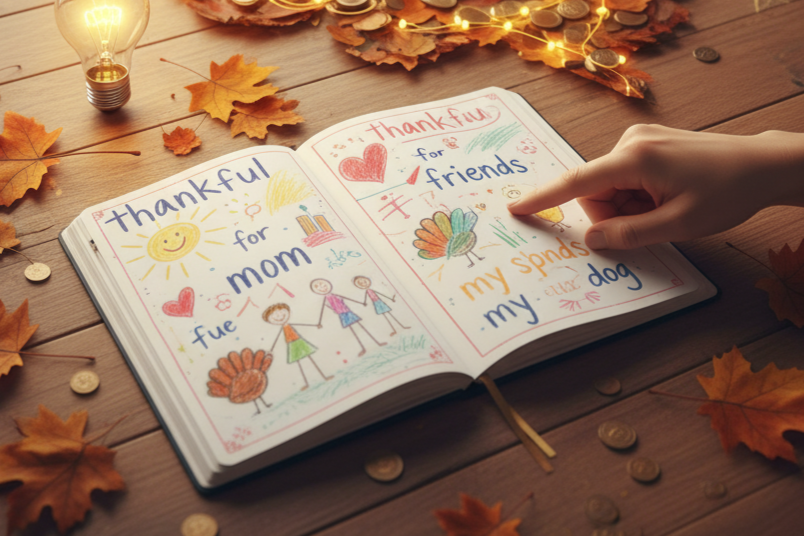
Gratitude journaling is one of the most researched and effective practices, and it’s easily adaptable for different ages.
Ages 5-7: Picture Gratitude Journal Young children can draw pictures of things they’re grateful for. Three times per week, have them draw one thing they appreciate. As they draw, ask questions like “Why are you grateful for this?” or “How does this make you feel?” This builds the neural pathways connecting gratitude and awareness.
Ages 8-12: Guided Gratitude Journal Kids in this age group can write 2-3 sentences about what they’re grateful for. Provide specific prompts that connect gratitude to money awareness:
- “What’s something I own that I’m really glad I have?”
- “What did I use today that I sometimes take for granted?”
- “What’s something free that made me happy today?”
Ages 13+: Reflective Gratitude Journal Teenagers can handle deeper reflection. Encourage them to write a paragraph about their gratitude, including why it matters and how it affects their choices. Include money-specific prompts:
- “What purchase from the past still brings me joy? Why?”
- “What’s something I wanted badly last month that I’ve forgotten about?”
- “What do I have that my friends might envy, even though I take it for granted?”
Family Thanksgiving Gratitude Rituals
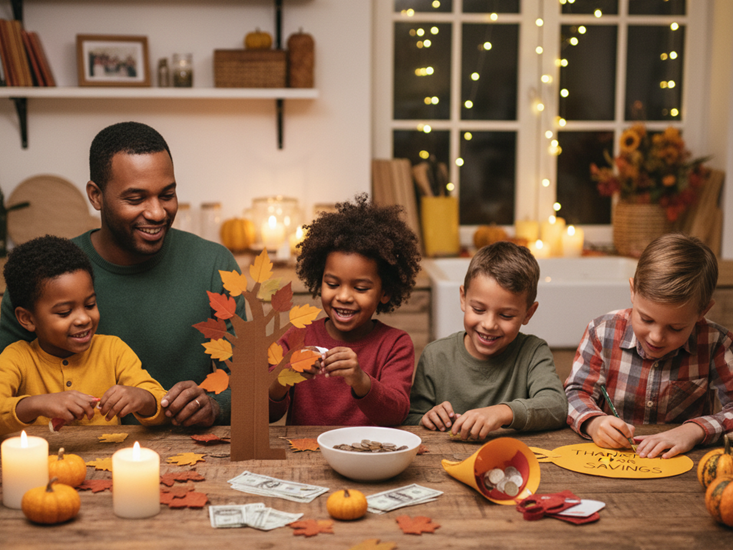
Individual gratitude practices are powerful, but family rituals create shared values and accountability. Here are three proven family gratitude practices:
1. The Gratitude Jar Keep a jar in your kitchen where family members drop notes about things they’re grateful for throughout the week. Every Sunday at dinner, read them aloud together. This creates positive anticipation and makes gratitude visible and communal.
2. The Before-Purchase Gratitude Check Before any non-essential purchase, pause as a family and ask: “What do we already have in this area that we’re grateful for?” This isn’t about creating guilt—it’s about conscious decision-making. Sometimes you’ll still make the purchase, but you’ll do so intentionally rather than impulsively.
3. Weekly Gratitude Discussions Dedicate ten minutes during one family meal each week to gratitude sharing. Each person shares three things: something they’re grateful for that they own, something they’re grateful for that’s free, and something they’re grateful for about another family member. This builds gratitude across different life areas and strengthens family bonds.
These rituals naturally translate to financial decision-making because they train kids to pause, reflect, and appreciate before reaching for their wallet (or yours).
Teaching Opportunity Cost Through Thanksgiving Gratitude
One of the most important financial concepts your kids need to understand is opportunity cost—the idea that choosing one thing means giving up another. Thanksgiving gratitude provides a perfect entry point for this lesson.
Here’s how to frame it: “When we’re grateful for what we already have, we can think more clearly about whether we really need something new, or if we’d rather use that money for something else that matters more.”
For younger kids (ages 6-10), you can learn how to explain the opportunity cost formula to a 10-year-old in ways that make sense for their developmental stage.
Let’s see this in a hypothetical scenario:
The Patterson family is deciding whether to buy their 9-year-old son a new bike. During their gratitude check-in, they discuss: “We’re really grateful you have a bike that works well. If we buy a new one just because it looks cooler, we won’t have money for the family camping trip we’ve been planning. Which matters more to you?”
Their son thinks about it and realizes he’d rather have the camping memories than a slightly better bike. This isn’t deprivation—it’s empowered decision-making based on values.
By connecting gratitude to trade-offs, you teach kids that money is finite and choices matter. They learn to ask not just “Can we afford this?” but “Is this the best use of our resources given what we already have and what else we value?”
Thanksgiving Gratitude and Smart Money Choices: The Long-Term Connection
The real power of Thanksgiving gratitude becomes clear when you look at its long-term financial impact. Let’s explore how today’s gratitude practices translate to tomorrow’s financial wins.
How Gratitude Builds Financial Patience

One of the most valuable financial skills is the ability to wait—to save for something meaningful rather than grabbing instant gratification. Thanksgiving gratitude directly builds this capacity.
When children regularly practice gratitude, they develop what psychologists call “temporal abundance”—the sense that good things exist now and will continue to exist in the future. This reduces the panic of “I need it NOW or I’ll never be happy.”
Research from the University of California, Riverside found that grateful individuals were 12% more willing to wait for larger financial rewards compared to control groups. That might not sound like much, but compound that decision-making pattern over a lifetime, and you’re looking at hundreds of thousands of dollars in better financial outcomes.
Think about it: A grateful child who learns to wait an extra year before upgrading their phone, who saves for three months instead of demanding immediate purchases, who resists impulse buys because they appreciate what they have—that child becomes an adult who builds wealth through patient, intentional choices.
The connection between gratitude and delayed gratification is so strong that these practices should be taught together for maximum impact.
Contentment as a Financial Superpower
In personal finance, one of the least discussed but most powerful concepts is “enough.” Grateful people have a clearer sense of “enough”—they know when they have what they need and can resist the endless upgrade cycle.
This contentment isn’t about settling or having low standards. It’s about recognizing satisfaction and not letting marketers define your happiness. When your child understands “enough,” they avoid lifestyle inflation—the tendency to spend more as income increases, which keeps people trapped in the paycheck-to-paycheck cycle.
Consider this: Two adults both earn $75,000 annually. Adult A, who practiced gratitude as a child, feels satisfied with a modest home, a reliable car, and occasional experiences with family. They save 20% of their income. Adult B, who never learned gratitude, constantly upgrades everything, compares themselves to wealthier peers, and saves nothing despite the good income.
The difference in their financial futures is staggering—not because of income, but because of mindset. This is where understanding abundance vs scarcity becomes crucial. Gratitude naturally cultivates abundance thinking: “I have plenty, and there’s enough to go around.” Scarcity thinking says: “I never have enough, and I must grab everything I can now.”
The compound effect of small gratitude habits creates enormous financial wins over time:
- Less impulse spending = thousands saved annually
- Greater satisfaction with current possessions = avoiding unnecessary upgrades
- Reduced comparison to others = not overspending to “keep up”
- Stronger delayed gratification = better investment decisions
From Thanksgiving Gratitude to Giving Back

One of the beautiful paradoxes of gratitude is that it makes people simultaneously more content with what they have AND more generous toward others. Grateful kids naturally develop empathy and the desire to share their abundance.
This generosity is actually an important financial literacy lesson. When kids give to others—whether through charitable donations, helping neighbors, or creating homemade Christmas gifts that teach kids money values—they learn several crucial concepts:
- Budgeting for others: You can’t give what you don’t have, so giving requires planning and resource management
- Value beyond price: Generosity shows that money’s purpose is impact, not just accumulation
- Gratitude in action: Giving is how we express thankfulness for our own blessings
Teaching kids to set aside a “giving” portion of their allowance or gift money reinforces both gratitude and financial responsibility. They learn that managing money well means you can be generous, which is a more inspiring message than “save money so you’ll have more for yourself.”
Practicing Thanksgiving Gratitude Year-Round: A Family Action Plan
The shift from Thanksgiving gratitude to year-round practice is where transformation happens. Here’s your action plan for sustaining gratitude habits that build financial responsibility.
Making Thanksgiving Gratitude a 365-Day Habit
One day per year—even one month per year—isn’t enough to rewire habits and mindsets. The families who see real financial behavior changes are those who make gratitude a daily or weekly practice throughout all twelve months.
The challenge is maintaining momentum after the Thanksgiving season ends. Here’s how to do it:
Create Monthly Gratitude Themes Instead of generic gratitude, give each month a focus that keeps things fresh and relevant:
- January: Grateful for warmth, shelter, and fresh starts
- February: Grateful for relationships and people who support us
- March: Grateful for learning opportunities and growth
- April: Grateful for nature, spring, and renewal
- May: Grateful for freedom and choices we have
- June: Grateful for summer, rest, and play
- July: Grateful for our country/community and safety
- August: Grateful for preparation and new beginnings
- September: Grateful for routines and stability
- October: Grateful for harvest, abundance, and traditions
- November: Thanksgiving gratitude for everything
- December: Grateful for giving, celebration, and reflection
These themes give you conversation starters and keep gratitude feeling dynamic rather than repetitive. You can even tie them to your New Year’s resolutions for kids, teens, and parents to create momentum in January.
Anchor Gratitude to Existing Habits The best way to maintain a new habit is to attach it to something you already do consistently. Try:
- Gratitude sharing during dinner (if you eat together regularly)
- Gratitude moment during car rides to school
- Gratitude reflection before bedtime
- Gratitude entry while kids do homework (you do it alongside them)
When gratitude becomes automatic—like brushing teeth—it requires less willpower and becomes simply “what we do.”
Gratitude Check-Ins Before Major Purchases
One of the most practical applications of Thanksgiving gratitude is the “gratitude pause” before spending money. This simple practice prevents countless regrettable purchases and teaches kids mindful consumption.
Here’s how it works:
Before any significant purchase (define “significant” for your family—maybe anything over $50 or $100), pause as a family and ask these questions:
- “What do we already have in this category that we’re grateful for?”
- “Will this purchase replace something we’re still grateful for, or add to it?”
- “How will we feel about this purchase in three months? Six months?”
- “Is there something else we value more that this money could support?”
This isn’t about creating guilt or never buying anything. It’s about conscious decision-making and ensuring purchases align with values.
Here’s a hypothetical scenario:
The Kim family is considering a vacation to an expensive resort. Before booking, they do a gratitude check-in. They’re grateful for their last family vacation (still recent) and realize they’d get more long-term value from investing in their daughter’s music lessons, which she’s been asking about for months. They book a simpler local getaway instead and use the extra money for lessons. A year later, they’re grateful they made that choice—their daughter’s confidence has soared, and they didn’t go into debt for a weeklong trip they would’ve half-forgotten.
Sometimes the gratitude check-in confirms that yes, this purchase aligns with your values and you should go for it. Other times, it redirects you toward better choices. Either way, it prevents autopilot spending.
Combining Thanksgiving Gratitude With Financial Goal-Setting
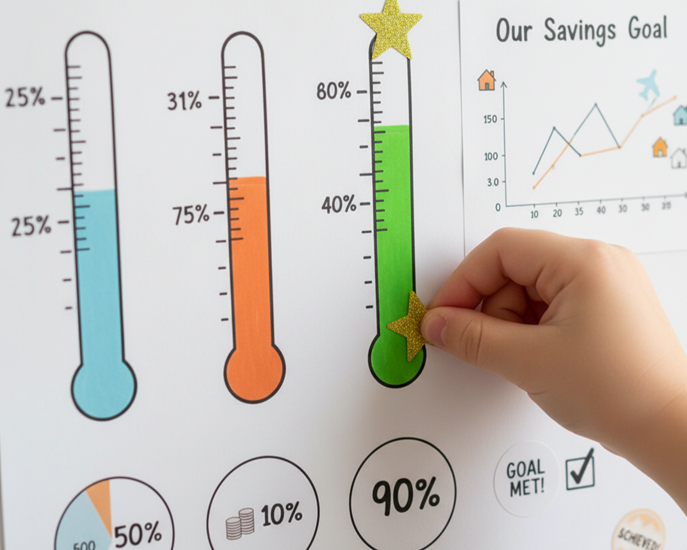
Here’s where gratitude becomes truly powerful: when you combine it with forward-looking financial goals. This creates a positive, abundance-based approach to saving rather than a deprivation-based one.
Traditional financial advice often sounds like: “Stop buying coffee so you can save money.” This is scarcity-based and makes people feel restricted.
Gratitude-based financial planning sounds like: “We’re so grateful for our home. Because we love it, we’re saving to make improvements that will make it even better for our family.” This is abundance-based and feels motivating.
Teach your kids to set goals using gratitude as the foundation:
- “I’m grateful for my current bike, and I’m saving to upgrade to one that fits me better as I grow.”
- “I’m grateful I can take art classes, so I’m saving to buy higher-quality supplies to improve my skills.”
- “I’m grateful for our family game nights, so I’m saving to buy a new game we’ll all enjoy together.”
This approach teaches crucial mindset differences:
- Abundance mindset: “I have good things now, and I can work toward even better things.”
- Scarcity mindset: “I can’t afford anything I want; life is hard.”
One creates motivation and optimism. The other creates resentment and impulsive rebellion spending.
You can extend this practice by creating a family vision board that combines gratitude for current blessings with excitement about future goals. This visual tool helps kids see that gratitude and aspiration aren’t opposites—they work together to create intentional, joyful financial lives.
Common Pitfalls (And How to Avoid Them)
Even with the best intentions, Thanksgiving gratitude practices can go wrong if you’re not careful. Here are the most common mistakes and how to avoid them.
When Thanksgiving Gratitude Feels Forced
Nothing kills genuine gratitude faster than making it feel like a chore or punishment. If your kids roll their eyes when you bring up gratitude, you’ve likely fallen into one of these traps:
Pitfall #1: Using gratitude as a weapon “You should be grateful for that toy instead of asking for more!” This shames rather than teaches. It makes gratitude feel like a tool to shut kids down.
Better approach: “I notice you’re not playing with that toy much anymore. What was it about that toy that excited you when you first got it? Let’s think about that feeling before we decide if we need something new.”
Pitfall #2: Only bringing up gratitude when saying “no” If gratitude only appears when kids want something, they’ll associate it with deprivation and disappointment.
Better approach: Practice gratitude regularly when there’s no purchase request involved. Make it about appreciation, not about denying wants.
Pitfall #3: Making it too complex or time-consuming If your gratitude practice requires 30 minutes of elaborate journaling every day, it won’t last past December.
Better approach: Keep it simple. Even “name one thing you’re grateful for today” at dinner is enough if done consistently.
Remember: The goal is to develop genuine appreciation, not to perform gratitude theater. Kids are remarkably good at detecting inauthenticity. If it feels fake to you, it definitely feels fake to them.
Avoiding “Toxic Positivity” Around Money
There’s a dangerous line between healthy Thanksgiving gratitude and toxic positivity—the idea that you should always be happy and grateful regardless of legitimate struggles.
When families face real financial hardship, telling kids to “just be grateful for what we have” can invalidate their feelings and create shame around discussing money challenges.
The problem with toxic positivity:
- It teaches kids to suppress legitimate concerns
- It creates unrealistic expectations about emotions
- It can make kids feel guilty for normal wants and needs
- It prevents honest family conversations about money
The solution: Realistic gratitude: Teach kids that they can be grateful for what they have AND acknowledge challenges AND work toward improvements—all at the same time.
This sounds like:
- “We’re grateful we have a home, AND we wish it was bigger for our growing family, so we’re saving toward that goal.”
- “I’m thankful for my clothes, but I’m also disappointed these shoes are wearing out. Let’s plan when we can replace them.”
- “Our family doesn’t have as much money as some others, and that’s hard sometimes. I’m grateful we take care of each other, and I’m working hard to improve our situation.”
This balanced approach validates feelings while maintaining perspective. It teaches kids that gratitude doesn’t mean pretending everything is perfect—it means recognizing the good even while working to improve circumstances.
It also reinforces an important lesson: You can acknowledge that others have more without falling into toxic comparison or envy. This is the heart of learning the difference between needs and wants—recognizing what’s essential versus what’s desirable, and being grateful for needs met while working toward wants.
Start Your Thanksgiving Gratitude Practice Today

Thanksgiving gratitude isn’t just about feeling warm and fuzzy during the holiday season—it’s one of the most practical, powerful tools you have for raising financially responsible kids. When children learn to appreciate what they have, they naturally spend less impulsively, save more consistently, resist marketing pressure, and make smarter long-term financial decisions.
The research is clear: grateful kids become financially healthier adults. They avoid the “more, more, more” trap that keeps so many people in debt, and understand “enough.” They make intentional choices rather than reactive ones. And they build wealth not through deprivation, but through contentment paired with purposeful goals.
You don’t need to implement everything in this article at once. Start small:
- Begin a simple gratitude practice this week—even just sharing one thing each family member is grateful for at dinner or reading gratitude quotes.
- Try a gratitude check-in before your next non-essential purchase
- Introduce a gratitude journal for your kids (adapt it to their age and ability)
The key is consistency, not perfection. A simple gratitude practice done regularly beats an elaborate one that fizzles out after two weeks.
Ready to put these principles into action?
Try these 15 Thanksgiving activities for kids that build gratitude and money skills through hands-on, engaging experiences your whole family will enjoy. These activities make gratitude tangible and fun, especially for younger children who learn best through play and practice.
Remember: The best financial gift you can give your children isn’t money—it’s a grateful heart that helps them make wise choices with whatever money they have. Start building that gift today, this Thanksgiving and beyond.
What gratitude practice will you start with your family this week? Share your thoughts in the comments below!